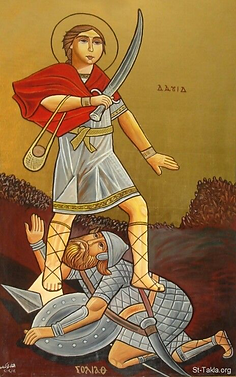
David the Prophet
The First Book of Samuel and the First Book of Chronicles both identify David as the son of Jesse, a Bethlehemite, and the youngest among eight sons. Additionally, he had at least two sisters: Zeruiah, whose sons all served in David's army, and Abigail, whose son Amasa served in Absalom's army, Absalom being one of David's younger sons. While the Bible does not mention his mother, the Talmud identifies her as Nitzevet, daughter of a man named Adael, while the Book of Ruth claims David as the great-grandson of Ruth, the Moabite, through Boaz.
David is depicted as solidifying his ties with various political and national factions through marriage. In 1 Samuel 17:25, King Saul promised great wealth, his daughter's hand in marriage, and tax exemption to the one who killed Goliath. Initially, Saul offered his eldest daughter, Merab, to David, which he respectfully declined. Merab was then given to Adriel the Meholathite. Learning of Michal's love for David, Saul married her to him after David paid a dowry of Philistine foreskins. Saul's jealousy led to attempts on David's life, and David escaped. Saul then gave Michal to another man, causing David grief.
The Book of Chronicles details David's sons from various wives and concubines. In Hebron, David had six sons, including Amnon, Daniel, Absalom, Adonijah, Shephatiah, and Ithream. With Bathsheba, his sons were Shammua, Shobab, Nathan, and Solomon. Other sons born in Jerusalem included Ibhar, Elishua, Eliphelet, Nogah, Nepheg, Japhia, Elishama, and Eliada. Jerimoth, not mentioned in other genealogies, is listed as another son in 2 Chronicles 11:18. David's daughter Tamar, by Maachah, was assaulted by her half-brother Amnon, leading to Absalom's vengeance and subsequent rebellion.
The narrative recounts Samuel anointing David as Saul's successor after Saul disobeyed divine commands. David enters Saul's service as a musician and gains popularity after slaying Goliath. Saul's fear of David's rising influence prompts attempts on David's life, leading him to flee. Despite opportunities, David spares Saul's life twice. David's adventures continue, including a stint among the Philistines and skirmishes with Saul's forces.
David eventually becomes king over Judah and later over all Israel. He conquers Jerusalem and brings the Ark of the Covenant there, intending to build a temple. However, God promises to establish David's dynasty forever. David faces personal trials, including his affair with Bathsheba and the rebellion of his son Absalom. Despite these challenges, David's reign is marked by military victories and alliances.
In Christianity, David is revered as a foreshadowing figure of Christ. His life, deeds, and Psalms are interpreted in the context of Jesus's messianic role. The Church celebrates David's feast day, viewing him as a significant figure in salvation history.
Coptic Icon: